Sugar and Salt (Poem)

Sugar and Salt

     The street at the top of the park hill

was an endless row of The Identical;

as if mirrors were aligned along the tarmac

on the road, reflecting the same seemingly ordinary,

seeming tangible, towering brown house over and over

into the infinite vanishing point.

     Before we could play, we had to call in to see

Lucinda in that beige house on that beige street.

She was like a grandmother we were obliged to

visit. But we weren’t related to her, not at all; nobody was.

The outside of the house was a Monet painting.

From far away, it was almost normal, almost pleasant to

look at if you squinted your eyes and tilted your head; but

as you stepped closer, it morphed into a toy house made of clay.

Like the houses you seem on film sets; those cardboard

cut-out constructions that you just know aren’t real.

     Her garden was pristine; picture-perfect. The flowers in the hanging

baskets looked natural but somehow like plastic at the same time.

Impeccably arranged – they didn’t dare move even slightly

in the chilling wind. Her gnomes lined the path to the front

door in identical proportion. Each one of their porcelain faces

had smiles so wide, they threatened to crack and split

their painted rosy cheeks wide open at any moment.

     Lucinda opened the door and ushered us in

straight away; she never crossed the threshold.

The inside of her two-dimensional house matched the

pathological perfection of the outside. Her varnished

Russian dolls lined the mantel piece in descending order;

equal gaps between them. The china display plates

mounting the cabinet were shiny and glazed; like her eyes.

Her mossy green leather couch of equal gloss, covered in plastic

that squeaked as you sat down. A strong chemical smell radiated from it;

a scent made your nose twitch, your eyes sting, and your head ache.

There was even something about the families of Wally dugs around

the fireplace; staring at me with inky black saucers for pupils.

     She gave us orange juice in her finest pretty pink china tea cups.

My hand trembled as I lifted the cup from the saucer to my lips;

sipping the juice that was so sweet, so concentrated; it was acid on

the tip of the tongue. Thrusting peanut butter chocolate bars

into our hands, she gestured for us to eat. The crunchy sugar and salt

granules of the chocolate filling souring; and crumpling our little faces.

     All the windows were locked tight; like she was afraid

of any fresh air seeping inside. The living room was stifling with heat;

humid, sticky warmth that would bead your forehead with a thin, slimy

layer of sweat. And the house stank: a pungent, overwhelming,

overbearing lemon that you could taste; that you could almost see

travelling in a gauze through the clammy, wavy air.

     Lucinda, herself, looked slightly different ever time

you saw her. A large head and upper body but small,

pin legs with fluffy pink slippers stuck on the ends.

Her googly eyes, even her toothy smile, were magnified and puffy;

out of proportion, and she moved with the edge of a ventriloquist dummy.

     The more I watched – studying her abstract expressions, observing

her peculiar motions – the more I thought of The Witches who used to

climb out the TV screen; frightening me as a small child.

As she towered over us, bestowing more chocolate and orange juice,

I was waiting for her to turn into one of them. With the prickly

sensation of ‘uncanny valley’ seeping to my bones, I waited

for her sickly skin to creep off; for her teeth and gums to

fall out in great chunks and smoulder on the perfect

pink carpet – and for her to turn into a monster.


As part of my creative writing class, we are assigned tasks each week to write a short story, poem or dramatic scene based on a prompt given in class. This week, our prompt was to write about the uncanny; essentially, to write an embellished creative non-fiction piece based on a place, a memory, that gave you the creeps. I wrote about a strange house and the old lady who lived in it who my friend and I visited as kids. This all stemmed from the strange smell in her house and as a child –  and even now as an adult (am I an adult?) – I let my imagination run away with me. I’ve always been fasincated by the idea of the hypothesis ‘uncanny valley‘ so I tried to incorporate that creepy feeling of something synthetic looking almost, but not exactly, real into the poem as well.

If you have any thoughts on this piece, please let me know in the comment section below!


Featured image courtesy of Flickr. Edited by Sophie McNaughton with Canva.

Featured on Student Journalism Blog: A Day in the Life of a Creative Degree Student

Featured (1)


 “A Day in the Life of a Creative Degree Student” by Sophie Dishman

We are into our fourth week of the a Day in the Life Series. To celebrate the series being around for a month, I decided to focus on students starting out in their creative careers.

This time I spoke to Sophie McNaughton, a 19-year-old student studying for a degree in English Literature, Journalism and Creative Writing at the University of Strathclyde in Glasgow. She is currently in her third year.

Here are the answers that Sophie gave to my questions!

» What is your job role?

I am the Regional Editor for Glasgow at The University Paper, a Copy-Editor for CultNoise Magazine and a contributing writer for magazines/newspapers including: The Strathclyde TelegraphScotcampusStudent Rag and Femsplain. I also have my own WordPress blog called moon child where I document all my work, both in fiction and journalism.

» How did you get into your job?

I got into writing for magazines in around December 2014 when I sent in an article to my university’s newspaper, The Strathclyde Telegraph. I wasn’t really expecting anything to come from it and I wasn’t even expecting it to get published but the editor was really happy with it and put it in the paper.

At that time, I wanted to steer clear of writing articles and focus on creative writing but, as time has passed, I have developed a keen interest in journalism. I love it now and I never thought I would. When I realised how much I enjoyed writing articles and editing, I started chasing up and pestering any and every magazine/newspaper that would let me write for them and ended up interning at Scotcampus and The National newspaper (Scotland), as well as becoming a contributing writer for several magazines.

» What do you like about your job?

I like how much creative freedom I have to write about things I’m really passionate about. CultNoise Magazine, for example, are really supportive when it comes to the subject matter I want to tackle. They provide me with a platform to do a lot of humorous, light-hearted pieces but I’m also able to write about bigger issues at CultNoise as well. I enjoy writing about current affairs and the causes I believe in, such as: animal welfare, LGBTQ issues, feminism, equality and everything else that I believe should be written and read about more.

I also really enjoy editing because I can be a bit of a perfectionist (or at least I try to be) so making tweaks and taking a piece of work to that next level of looking polished and presentable is something I enjoy. I sound like such a geek but it’s actually quite fun. I enjoy working on the whole technical side too as I get to source and edit images, learn about copyright and media law, and help to manage social media links. If I ever decide to go into editing full-time after university, it’s all great experience and it’s good to be able to get some practise.

» What are some of the challenges of your job?

The biggest challenges with the work I do is probably trying to maintain a balance between my coursework and my work outside of my studies. Since I write for magazines and have a lot of deadlines outside of university, it’s sometimes hard to manage my time well and make sure I’m not spreading myself too thin. I’ve become a bit of a workaholic over the last year and I’m always taking on new projects and chasing new opportunities that I probably don’t have time for but somehow I manage to squeeze everything in, along with a few meltdowns.

I like to be challenged and I sometimes think a little bit of stress can actually be a good thing because it pushes you to work hard and make a real effort. One of the biggest things I struggle with in terms of university is keeping up with all the reading we are assigned. As I do a literature course, naturally, there is a lot of reading involved but a lot of my free time goes to creating stories and articles and my other writing commitments so keeping up with the reading lists is sometimes a bit of a push but I still study hard and make sure I get the best possibly grades I am capable of. I think it’s important to make an effort at school/college/university but I think gaining work experience outside of your studies is essential if you want to succeed in a competitive field when you graduate.

tumblr_niagx32v8S1qic217o2_1280

» What do you think are some of the challenges in the creative sector?

I think the creative sector is rife with challenges because a lot of the courses in creative industries don’t necessarily lead to one set, stable career like a lot of other types of courses do, so you really need to figure out how you want to utilise your degree and make it work for you. Another hurdle to get over is that a lot of people have a preconceived idea of those who have creative/humanity degrees and don’t consider them to be as significant as a degree in the sciences for example which is completely inaccurate and disrespectful. So there will be a certain stigma when you tell people “my degree is in…” but it’s important to remember that this is just ignorance and something you shouldn’t waste your time dwelling on. You should always do whatever makes you happy, no matter what anyone else thinks.

I think it’s important to always make choices with your education to suit you. If you follow the path someone else wants for you, then you’ll never really be happy in what you do. Another big challenge in journalism specifically is finding paid work. As a student, almost all the work I do is unpaid, which I don’t mind at this stage because I love what I do and I know that a lot of the publications I write for are free and most of the other writers work on an unpaid basis too. But, once I graduate, I can’t see myself working for free because I think everyone should be paid for their services, no matter what kind of work it is.

» How has your degree helped you?

My degree has helped me learn: the basics of examining and analysing literature, the rules and formulas for writing journalistic articles, and how to enhance my fiction writing. But I also think that all the extracurricular work I’ve done in the past year has been immensely valuable because I’ve learned so much in such a short space of time. I would advise anyone doing this type of degree to gain experience outside of university because it allows you to develop skills and learn things that you probably won’t get in the classroom. Just being at university and meeting new people has really helped too because a lot of the opportunities I’ve had have come from lectures, tutors and fellow students. CultNoise Magazine is an example as I first heard of them when a university email was sent out to us appealing for student writers so I’m glad I responded to that!

» Why did you pick to work the sector that you work in?

I don’t think I even really “picked” this section. I kind of stumbled into it when I was trying my hand at journalism and discovered that I really enjoyed it. I plan to keep on writing for magazines and newspapers but I also enjoy writing fiction and it was definitely the first thing I really loved in terms of writing. I think making it in fiction is a lot harder because there are so many amazing fiction writers out there and opportunities to get published might not be few and far between but they’re definitely hard to get into. Most literary magazines/journals are so specific with the style and genre they want that it’s really creatively restrictive and stifling which isn’t a good thing at all. I also think there is a certain degree of pretention and snobbery within literary magazines which isn’t fair and actually damages a publication’s reputation in the long-term. I definitely think there needs to be more in the way of inclusive literary magazines and students should definitely get more involved with contributing and creating them themselves.

» Describe a typical day in your job.

If I’m not at university, I try to get up early and have one or two articles written by noon. Some days, I’ll be editing articles online for CultNoise Magazine or I’ll be scrambling around and emailing people trying to get articles together for the latest edition of The University Paper. In between that, I’ll be updating my blog with my latest articles, reviews, short stories, and/or poems when I get a chance. I’m pretty much always busy and while I like to go out with my friends or chill out and do nothing or just watch TV sometimes, I’ve started to really hate not being busy which I suppose is a good thing. If I don’t have anything to do, I’ll usually find something.

» Any advice for people wanting to get into your sector and/or the creative industry?

I’m probably not in any place to be giving advice but one of the most important things for me was developing a thick skin. You could be at university and put your heart and soul into an essay and you could think “This is my best work, I’ll definitely get an A for this” and then you could get a bad mark and harsh feedback that completely tears your work apart but I would just say, don’t let anything like this discourage you. No matter who you are or what you do, someone will always be critical of what you do and that’s okay.

I think if you become your own harshest critic, then no one else’s criticism will ever hurt your feelings and you can instead use it as ammunition to improve and learn a lesson from the experience. It’s important to be passionate and not let yourself be disheartened. If a tutor doesn’t like your coursework, arrange a meeting with them and find out what you’re doing wrong. If you editor criticises your article, write something even better to prove to them that you’re talented. Just always work hard. I think that’s the main thing.


I’d like to say a huge thank you to Sophie for allowing me to feature in her “A Day in the Life” Series.

You can also read Sophie’s guest blog for ‘moon child’ where she talks about her view on Scottish Independence.

Featured image created on Canva, edited by Sophie McNaughton.

Guest Blog: “An English Girl’s View on Scottish Independence” by Sophie Dishman

Introducing ‘moon child’ guest blogger: Sophie Dishman!

11429872_804417526332227_2152456830230444518_nI am a 21 year old student studying Journalism at the University of Sunderland. I have a keen interest in politics and international relations as well as mental health, carers issues and disability.

I am also a blogger and Youtuber, writing and talking about my experiences of being a student and more. I have keen interests in all areas of journalism, but my particular favourites are radio, print and online journalism.

Previous to studying journalism, I was a social work student at the same university.

You can follow Sophie’s work on her blog Musings of a Journalism Student, on her Twitter and Facebook profiles and YouTube channel.


Guest Blog- -An English Girl's View on Scottish Independence- By Sophie Dishman

“An English Girl’s View on Scottish Independence” by Sophie Dishman

It’s just over a year since the Scottish Independence Referendum. A whole year on since Scotland said ‘No’ to becoming independent from the rest of the UK. I have to admit that I’m not entirely knowledgeable in this particular area of politics, so you will have to bear with me on that one.

What I do know is that for people in England, we were waiting. Waiting with anticipation. I cared about what happened. I used to live near Scotland so you could say I had some vested interest. People over the age of 16 were able to vote in the referendum (something I would love to happen in England too) and to contribute towards the decision that would affect the future of their country.

Devolution of power is a controversial subject anywhere in the UK. Some people want power devolved to local councils, others want London to control all of the money. That’s where opinion is split. Scotland wanted a majority devolution of power, whilst keeping the monarchy and the pound. In England, or in my own little world, I like the pound and I like the monarchy, but I want power to go to my local council to decide where the money is spent. I want them to hold the purse strings.

However, if I lived in Scotland, I think I would have voted to stay in the UK. I think the people of Scotland benefit a lot from being with the UK – free university education if you study in Scotland being one of them. London provides Scotland with the money to do that. Why would you want to leave? That is just my opinion though. I’ve never lived in or visited Scotland (but I will someday!) so my perspective is a little limited.

I should mention the First Minister of Scotland, Nicola Sturgeon and of course, SNP’s Mhairi Black, the youngest MP in Parliament for 100 years. Two powerful women, I may add. Nicola championed the ‘Yes’ camp, along with the then First Minister of Scotland Alex Salmond, campaigning for Scotland to be removed from the UK so it could stand on its own two feet. That was Nicola Sturgeon’s belief and she stuck to it. Mhairi Black on the other hand is championing the voice of young people. To be honest, these are two of the most identifiable people in Parliament at the moment, besides the Prime Minister David Cameron and Chancellor of the Exchequer George Osborne.

So in short, I did care about the referendum. But I don’t think it would have affected me personally to a great extent. I think that Nicola Sturgeon had a great campaign, but evidently it wasn’t meant to be. Maybe next time?


A few words from the primary blogger – I chose to feature a guest blog by Sophie because I think she is an extremely talented writer and journalist. I love Sophie’s blog and even though she has only just started her journalism degree, she already has a huge head start as she has created an excellent portfolio of work for great causes including mental health and carers issues.

You can also read Sophie’s blog post where I feature in herA Day in the Life Series” to talk about my experience as a Creative Degree Student.

If you’d like to guest blog for ‘moon child’, visit the guest blogging page for more information.

Featured image made on Canva by Sophie McNaughton.

What do you think about Scottish Independence? Let us know in the comment section below.

September Musings: Self-publishing and going back to uni

1September is always a busy month what with going back to university, settling back into regular classes and a routine, and getting ready for winter (I’m desperately trying to hold myself back from buying the entire knitwear section in Primark) so I haven’t been posting as many blog posts as I ordinarily would have this month. So, to keep moon child ticking over, I thought I’d create a little September Musings post to talk about my little self-published book’s first birthday on September 25th and entering third year at university.


Self-publishing

Exactly one year (and *cough* two days *cough*) ago, I self-published my first little book: Ivy Moon and Other Short Stories. At that time, I was just starting my second year of English, Journalism and Creative Writing at the University of Strathclyde and having accumulated a fairly decent sized portfolio of work in my creative writing class – where we’d write a short story, poem or dramatic scene every week – I decided I wanted to do something with that body of work.

While creating a physical portfolio in a big folder with page dividers, stickers, freshly printed pages and other assorted, colourful stationary did sound appealing, I wanted to do something different with my little collection of stories and to display my work in a different way. That’s when I discovered Lulu, a self-publishing website where you can create and design your very own books with every style from hardback and paperback to eBooks and photobooks.

Logging on to Lulu, I went to work straight away to put all my stories together in one Word document and began to build my own little book:

» Short fiction collection – “Ivy Moon & Other Short Stories

‘Her irises had the texture of reptile scales, like small circles of crinkled foil or thin flakes of gold. They burned a radioactive, liquid, lime green that morphed into a murky mustard shade of yellow with the changing sunlight.

Even her dense, muddy pupils were hypnotic with their way of dilating and stretching to inky black saucers when she was excited and shrinking to tiny, devilish slits when she was angry. She stood at five foot seven, a few inches shorter than myself with the slender body of a woman but the long, swishing tail and soft, fluffy head of a cat…’ – Extract from short story Feline.

“This collection contains nine short stories which include elements of gothic horror, fantasy, science fiction, romance, tragedy, historical fiction, surrealism, folklore, fairytale and the paranormal. These pieces were written by 18-year-old English Literature and Writing student, Sophie McNaughton during her first year at university.”

→ You can buy my short story collection from Lulu, Amazon and Barnes & Nobles.

Self-publishing has a lot of advantages. Firstly, it’s very simple to do and very quick. I put my book together essentially in one night and by the next week, I was holding my own little book with my name on it in my hands. Secondly, if you’re lucky enough to have your little self-published book go viral like Estelle Maskame, you will receive around 70% of the proceeds your book makes whereas traditional publishing would see you receiving a much smaller percentage of the dosh.

I also liked self-publishing because it’s a much more creative, artistic and innovative way of showing off your work as oppossed to the traditional portfolio. And your self-published book is a great thing to have and look back on when you’re old and grey and can’t quite remember writing it in the first place. It’s also a good thing to keep in mind when it comes to the dreaded dissertation in your last year at university. Instead of burying your dissertation when it’s done and desperately trying to forget the blood, sweat and tears it caused, you could showcase it in your own little book and be, quite rightly, proud that you managed to get through it.

So my little book has turned 1 and my new collection Moon Child: Collected Essays is still just a baby. You can view my self-published work both with Lulu and Kindle Self-Publishing here.


Going back to uni

This week marks my first week of third year. I still find it hard to believe I’m in third year (and more than half way through my degree) already when I still feel like I’m in school. The great thing about uni this year is that all my classes are great. Along with the obligatory but still enjoyable core class, Victorian Literature, I’m also doing another module of Creative Writing: Short Fiction and Poetry, a creative non-fiction class called Writing Real Life, and a literature and film class called Adaptations.

I’m particularly loving Adaptations right now as we have a film screening every week as well as a lecture and tutorial where we learn about the art of adapting a literary work into a work into a work of cinema and discuss the techniques used and principles that should be adhered to. We’re doing a lot of great texts/films including In A Lonely Place, Picnic at Hanging Rock and Crash, and I’m just counting down the weeks until we do Trainspotting towards the end of the semester which, anyone who knows me well will know, is my favourite film and one of my favourite books.

Going into third year is also a bit scary because at the end of this year I will, hopefully, have a degree. I plan to stay on to do an honours year and I imagine I’ll probably try to go on to specialise in either creative writing or feature writing in an MA course but it’s strange to think that I will have a standard degree in under a year from now. Quarter-life crisis, anyone? Why yes, I would love some. Wish me luck!

  • I have plenty of new blog posts, guest blogs, reviews, articles and works of fiction lined up to show you all soon so stay tuned the rest of this month and into November!

Featured image created with Canva, edited by Sophie McNaughton.

Sophie’s Choice: This Is England ’90 (TV Review)

Sophie's Choice_ This Is England '90 (TVSunday night marked the long-awaited and highly-anticipated return of Shane Meadows’ award-winning drama series This Is England; in the form of its last instalment, This Is England ’90. Following on from the film set in 1983 and subsequent drama series set in ‘86 and ‘88, viewers have watched little Shaun (Thomas Turgoose) grow up on screen and seen the cast adapt and change with the fashion, music and sub-cultures of the times as well as having to go through horrendous struggles and harrowing storylines along the way.

The premiere episode of the final chapter opens in Spring as the gang have ditched their Dr Marten’s, Fred Perry’s and skinheads and have opted for neon coloured t-shirts, denim dungarees, bucket hats and a revitalised spirit that was born in the 90s as working people had hope again. Rick Astley and The Jam are out; and The Stone Roses, Blur and Happy Mondays are well and truly in.

Introduced with Meadows’ signature opening montage of momentous moments from the decade, we see: Thatcher leaving Downing Street; the Strangeways Prison riot; the then-golden boy of English football, Paul “Gazza” Gascoigne, being sent off the pitch at the 1990 World Cup semi-final; the Poll Tax riots; and much more as Meadows expertly encapsulates the biggest pop culture moments of the 1990s.

This time around on the Sheffield council estate, Lol and Woody are back together and living in their own flat with a new baby which, after years of misery and heartache for the couple, is a very welcoming sight.

For the most part, the gang are happy and settled, but if we can expect anything from Meadows, it’s that things are going to get a lot darker. Towards the end of the episode, in amongst rave music and ‘sniff-banging’ (don’t even ask), Shaun gets into a fight with his ex-girlfriend and born-again-goth Smell’s new fella and his group of head-bangers and grunge fans at the Madchester night at the town hall. Still harbouring feelings for his ex (who he was caught cheating on in ’88), we find Shaun weeping on his own and wondering what to do with his life (college just isn’t his “cup of tea”) and how to get Smell back.

Another cause for concern in this seemingly happy opening episode veiled with subtle hints of darkness is Kelly. While the gang socialise, catch up and have a laugh at the Madchester night, Kelly is frequently seen taking speed and dancing on her own amongst the crowd.

In this episode, the sun is shining and the drinks are flowing, and things might just be looking up for the gang. But as they are graced with a bit of comic relief in this opener, something tells me that Meadows has some dark tricks up his sleeve to shake things up.

In next week’s preview, we see the return of the legendary pint-sized-psycho, Combo (who took the wrap for Lol killing her abusive dad and went to prison for her in ‘86); the gang go on a road trip filled with booze, drugs and raves; and the ‘happy times’ slowly start to unravel.

One of the best things about Meadows’ evocative, colourful, time-travelling, back-to-the-future culture creation – aside from gripping drama performed by incredible acting talent and the kind of harrowing yet hilarious storylines that we see in series like Channel 4’s Shameless – is how the costumes and soundtrack inspire nostalgia about the look and feel of the 90s; casting viewers back to the ‘good old days’ when the Internet was just a baby and you couldn’t Sky+ your favourite TV programmes. But Meadows also has a raw, unrivalled talent of bringing back the history of these years and showcasing how the iconic, and sometimes devastating, events of the 90s affected Britons and shaped the entire nation.

The next episode of This Is England ’90 airs on Sunday, 9pm on Channel 4. You can catch up with the first episode on 4od.

Read more about theThis Is England film and series here as I take an indepth look back at ’83 – ’88.

How to Have the Best Movie Night

This is a sponspored blog post.

Do you know how much I paid for a ticket the last time I went to the cinema? £8, and £16 on top of that for two small popcorns and a medium portion of nachos. Admittedly, there’s nothing quite like going to the cinema and seeing films on ‘the big screen’ but when you’re a student surviving on SAAS and trying to make that precious payment last the entire month – on top of the cost of uni books, car insurance payments, mobile phone contracts etc. – even a trip to the cinema can be a bit of a stretch these days.

So, why not cut out the middle man? Instead of going to the cinema, go to the supermarket and buy some new DVDs – you’ll probably get a few for the price of a cinema ticket – and some bags of popcorn, and have your very own movie night – at home! Here is moon child’s guide on what you’ll need to have the best movie night:


Snacks

4836013826_12054ff0ec_oFood is always my first port of call when it comes to trips to the cinema or movie-nights-in alike, so snacks are of paramount importance. The classic movie snack is, of course – popcorn!

Whether you like butter, sweet or salted, or sweet and salted, you’ll be able to grab a huge bag for at least half the price than the cinema stuff and, surprisingly, the supermarket brands are just as good.

If you’re not in the mood for popcorn, there are loads of other movie snacks you can munch on during your favourite films. Nachos with cheese and salsa (I’d recommend adding spicy chicken too!), Ben and Jerry’s ice-cream (cookie dough is a must), crisps, sweets or, if you fancy, why not have pizza, hot dogs or burgers?

(This is definitely not a healthy-eating-movie-night. Apologies.)


Setting

Now I’m not saying that Harry Potter was lucky, per se, to have a loveless childhood, dragged up by an aunt and uncle who despised him. But he did get to live in the cupboard under the stairs – think how cosy it must have been!

Well, maybe it wasn’t that cosy, but there’s something about the idea of that little cupboard that always reminds me of building dens as a child with pillows, blankets, fairy lights, sweets to eat, and ghost stories to read.

So, why not make your movie night that extra bit cosy and comfy by building a den in your livingroom? Just make sure you leave part of the blankets open to see the TV, or even move the telly inside the den and hide away from the outside world completely!


Theme

5928828397_23b84eed65_bIf, like most of us, you’re part of a particular fandom – Lord of the Rings, Harry Potter, Disney, Game of Thrones etc. – you could do something that you can’t do at the cinema which is have a mammoth marathon of your favourite TV/film series.

Watch Harry Potter back to back right from Year 1 in the Philosopher’s Stone right through to the ultimate showdown between ‘The Boy Who Lived’ and the Dark Lord himself in the Deathly Hallows Part 2, or binge on Doctor Who until your heart’s content. If you’re inviting a group of people over, you could make it a themed night with costumes, games and fandom-appropriate treats.

While it might feel a little juvenile, who wouldn’t love fandom movie night with lots of sweet treats and a binge-watch of their favourite films? You’re never too old to geek out over your favourite movies.


What to watch…

Deciding on your viewing can be a tricky one if you’re trying to pick a film that will please everyone. So, going through some different film genres, here is my pick of classic, fan-favourites…

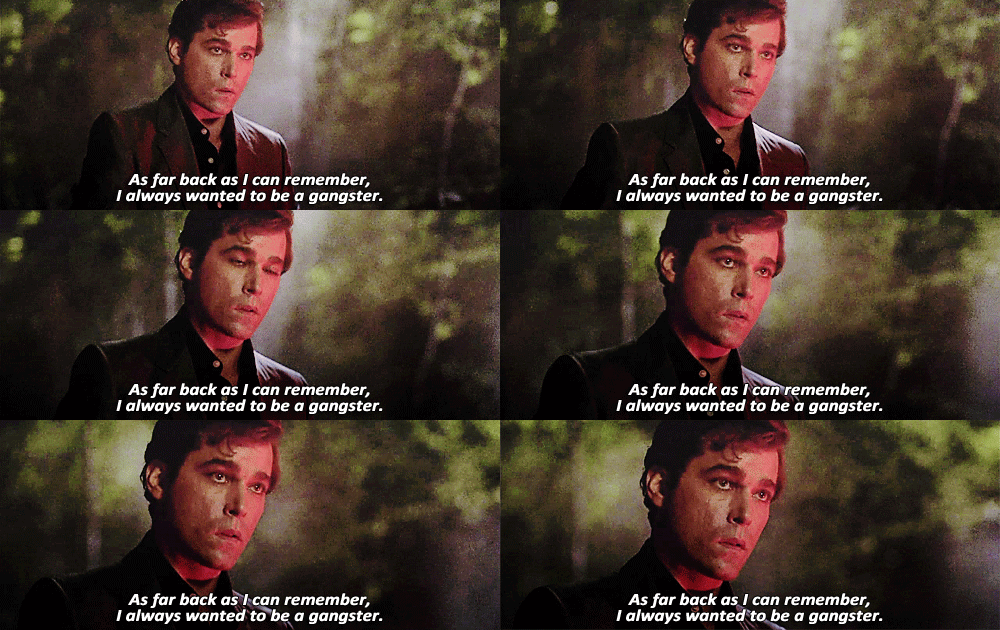
CrimeGoodfellas

Goodfellas is the ultimate gangster blockbuster telling the rise and fall chroncile of Henry Hill, a young boy raised in the bossom of the Italian-American mob and turned into an unpredictable, violent, drug-taking gangster.

Rom-comClueless

Perfect for a girly night in, this iconic, 90s cult classic is a huge click flick hit telling the story of Cher; a rich, LA daddy’s girl who surprises herself when she falls for a do-gooder, becomes a charitable goddess and proves to everyone, including herself, that there is more to her than just being a natural beauty and a fashion guru.

EpicBraveheart

Yes, yes, I know – it’s wildly historically inaccurate but let’s remember that it’s a Hollywood work of cinema, not a BBC documentary of the Scottish Wars of Independence. The epic 1995 film (loosely) tells the tale of famous Scottish historic figure, William Wallace, who fought and died for – FREEDOM! Say what you like about the complacent fact checkers for this production, it is still a brilliant film.

DramaTrainspotting

Okay, I’m a bit biased here because it’s my favourite film (ever) but Trainspotting is definitely worth sticking on the “one to watch” list. Trainspotting follows heroin addict Mark Renton and his group of friends immersed in the Edinburgh drug scene of the late 80s-early 90s. This gritty, hilarious/harrowing, generational, art house film is a long-time favourite picked up and worshiped by  young people around the world.

Sci-fiAlien

This science fiction classic from the 70s is another cult classic and firm favourite with film fans. The commercial vessel Nostromo receives a distress call from an unexplored planet, and after searching for survivors, the crew head home only to realize that a deadly alien has come along with them, hiding in a rather, shall we say, inconvenient place.

What films do you watch on movie night? Let us know in the comments section below.

If you’d like me to write a review or a sponsored post for you/your company, email me at: sophiemcnaughton.xo@outlook.com

Film Review: Legend

Published by Student Rag.

People are often surprised to hear that I’m a huge fan of gangster films. I love them so much that I even have a huge make-shift canvas up on my wall featuring characters from Scarface, Goodfellas, The Godfather and many more all gathered round a poker table. But one of my all-time favourite gangster movies is The Krays; the chilling and eerie but stunning 1990 film starring brothers Martin and Gary Kemp which tells the rise and fall chronicle of the notorious Kray twins who dominated London in a reign of violence and intimidation in the 1960s.

Considering how much I adore the original film adaptation based on the book ‘The Profession of Violence: The Rise and Fall of the Kray twins’, I was a bit precious about the idea of a re-make, but when I heard Tom Hardy would be starring as both Ronald “Ronnie” (“the one man mob”) and Reginald “Reggie” Kray (“the gangster prince of the East End”) – an impressive feat in itself, if achieved – I was intrigued to see how this re-telling of the story of Britain’s most infamous-gangsters-turned-surprising-national-treasures would pan out.

Legend is a revitalised, re-energised take on the Krays twins’ story with impeccably glitzy costume and set design that could easily rival the nostalgic, stunning look of The Great Gatsby (2013). The class, suave style and sexiness of the film is instantly apparent as the movie opens with Reggie (the front) and Ronnie (the muscle) smoking cigars in the back of a chauffeur driven car driving through star-studded, swinging ‘60s London with a Cockney voice over from Reggie’s wife, Frances Kray (maiden name: Shea).

The real Ronnie and Reggie with Frances.

While this indulgence in the glamourized East End folklore of the twins may not be an entirely explicit, graphic and wholly honest portrayal of the Krays – figures who have been mythologized and turned into iconic, nostalgic characters of 1960s Britannia – no critic can deny that this film is still a brutal, spunky, unapologetic adaptation which might make audiences laugh at times but which also ponders sobering questions, particularly regarding the mental health issues and wellbeing of Ronnie Kray, who was eventually certified insane and became a patient of Broadmoor psychiatric hospital (an aspect of his life that the 1990 does not touch on, and instead portrays Ronnie as merely a lover of violence).

Although the narrator of the film, Frances, died from suicide not long after she and Reggie married (a piece of trivia I already knew from the 1990 film), I thought it was an inspired touch on behalf of the director to have the film concentrate on the story from her perspective; the movie is very much focalised on the beloved Reggie Kray through the eyes of Frances, and, essentially, from beyond the grave.

Shown, to a certain degree, as caricature portrayals of each twin, Tom Hardy delivers two engrossing and compelling performances as – similar to the tale of Dr Jekyll and Mr Hyde – Hardy is able to switch personality from the softly-spoken, handsome, gentlemanly and intelligent yet still violent and not-to-be-messed-with Reggie Kray, into his vicious counterpart: the paranoid-schizophrenic, blood-thirsty, unpredictable and terrifyingly violent yet hilarious, Ronnie Kray.

With subtle characterisations and mannerisms including: Ronnie’s deeper voice; how he breathes heavily and shows his bottom row of teeth more than the top; how he wobbles and swaggers with a fat cigar in his hand; and Reggie’s way of slicking back his hair; placing a protective hand on the small of Frances’ back wherever they go; and his sweet, innocent, butter-wouldn’t-melt voice, Hardy hones the characteristics of these two very similar but paradoxically very different brothers to create two vivid, rich, multidimensional performances.

Following the twins rise as they buy and run clubs in London (gained largely through intimidation), make contacts with the big boys of Las Vegas and become socialites and even celebrities of 1960s pop culture, we then see their empire begin to crumble around them as Ronnie’s side-splitting one liners (“I prefer boys. Mostly Italian but I’m not prejudiced. And I’m the giver, not the receiver. There’s a different, you know – I ain’t a faggot.”) fade and he becomes increasingly violent, paranoid and unable to be controlled by anyone other than his brother and with rival gangsters and the police baying for Kray blood, Reggie, too, begins to crack under the pressure and violently lashes out on poor Frances with the audience watching on in horror as he comes more and more like his psychopathic brother.

With an explosive, ferocious and climactic scene towards the end of the film as Reggie snaps and repeatedly stabs fellow notorious gangland figure Jack “the Hat” McVitie to death in a crowded room at an East End party, we see Frances’ beloved Reggie turn into a monster while his ‘evil twin’ brother remains calm and asks him “what’d you do that for?” – a surreal, role-reversal exchange spookily similar to an earlier one in the film between the brothers, but this time Ronnie is the sensible voice of reason and Reggie is the wild animal covered in another man’s blood.

For the critics who sneer and have been slating Legend because of its slightly cartoonish, embellished and perhaps a little generalised portrayal of the Krays, I can partly understand their aversion. But I, like many others, thoroughly enjoyed this sophisticated, violent, art-house-with-a-big-budget depiction of London’s most infamous criminals and it is definitely a film I would recommend to gangster-film-virgins and dire-hard-fans alike.

Legend is out in cinemas now.

Have you seen the film? Let us know what you thought of it in the comments section below.

Sophie’s Choice: First Dates (TV Review)

Published by Student Rag.

I’m a bit of a long-time fan of First Dates. As a bit of a cynic myself, I appreciate and commend the nervous, hopeless-romantic singletons as they toddle sheepishly into the First Dates restaurant – an eatery where nobody, apart from the staff, have ever met before – for their blind date with a seemingly compatible stranger, carefully selected for them by the good folks at Channel 4 – what could go wrong?

Moving away from our new Tinder-obsessed society and taking a step back to the traditional-ish, meet cute approach to love is a breath of fresh air in comparison to some of the “dating” shows we see on TV today. First Dates is surprisingly charming, funny and heartwarming as underneath the superficiality of the long list of requirements (height, hair colour, build, dress sense etc.) and past experiences of dodgy relationships and casual flings, the singles are – for the most part – genuinely decent people who really are looking for love.

Of course, in the First Dates restaurant, there is still a fair bit of cheese (pun intended) with embarrassing pick-up lines, cringe-worthy compliments and those singles who simply don’t have any manners – saying you’re off for a “slash”, as we saw in the previous series, is hardly appropriate first date etiquette by any stretch of the imagination. But even these occasions are not in fact rage-inducing and painful to watch as we might expect. Instead, they are comical and innocent enough that the viewer can laugh them off.

3265680069_ea254bdffb_o

On Thursday night, we saw the opening of the new series of First Dates as we met Louis, 25, from Oxford – a painfully shy, hilarious and extremely chivalrous gent who had viewers saying “Aww” at his cute demeanour before his date had even arrived. Louis’ date was 26-year-old Adele from Manchester who was looking for someone who, unlike her last date, wouldn’t burp in her face. Who says romance is dead?

As they pair met and began to chat, we soon saw Louis crumble under pressure, trip over his words and clam up as he tried to initiate conversation with Adele. As it quickly became apparent that Louis’ confidence issues were getting the better of him, Adele graciously started chatting and soon put him at ease.

One of the funniest moments of the episode was as the pair sat down at their table, Louis reached for his go-to conversation starter: politics. As they conversed and we discovered that Louis is a Tory and Adele leans towards the right, Louis made the argument that differing political views should never stand in the way of love:

“I find Labour supporters saying ‘I could never go out with a Tory’, but why not? Coalition is flavour of the month!”

To which, Adele answered: “That should be your new pick-up line!”

Sadly, love did not blossom between the adorable pair and while Louis was disappointed, he took the rejection well, and taking on board Adele’s honest and admirable advice that he has every quality a girl could want – manners, intelligence and wit – but lacks confidence, Louis has decided not to give up and will be set up on another date next week.

As well as being a fan of the show, I now have another reason to watch next week as I’m dying to see my new favourite First Date-r.

The next episode of First Dates is on Thursday, 10pm on Channel 4.


Featured image courtesy of Brent Moore via Flickr.

Guest Blog: “Tips for Studying English at University” by Abigail Wing

Introducing moon child guest blogger: Abigail Wing!

11118992_10206338560198796_1824000551_nMy name is Abigail and I am a student at the University of Stirling studying for a degree in English. Ever since I was little I have had a profound love of books that has inspired me to pursue a career in publishing. My passion for reading also translates into a desire to write. Therefore, I regularly post over at my blog The University of Real Life which is an honest account of university life featuring advice, anecdotes and even recipes.

» You can follow Abigail on Twitter and Instagram and follow her work on her blog.


“Tips for Studying English at University” by Abigail Wing

How does Voltaire like his apples?*

Those who can hazard a guess at the punchline to this joke most likely harbour a keen interest in English Literature. Perhaps you are getting ready to begin studying for a degree in English this very month. If so, then what are the chances of you stumbling upon this teeny tiny article floating amongst the red giants of internet space? I don’t know. I am studying English, not maths or astronomy… but I like a metaphor when I see one. I am shameless like that.

I may not know much about numbers or space but I do know that studying English can be a really stressful process at times. I also know that it can be an interesting and fulfilling way to spend part of your life. If you have chosen to study English because you too believe that it is the only way to feed your hunger for higher education then read on. These are a few things to remember – or reminisce – about studying English Literature at university:

1.      Get used to the fact that everybody thinks you want to be a teacher

Spend some time thinking through a response to said assumers that won’t get you arrested for grievous bodily harm. Not only is this person’s banal guess at your future career extremely annoying, it also displays an alarming amount of ignorance concerning the prospects of an English Literature graduate. Rest assured that there are a variety of career possibilities open to you at the end of your degree (although they can very competitive) and that being teacher is just one of them.

2.      Remind yourself every day that your degree is not a waste of time

A huge percentage of the people I am friends with are studying for scientific or mathematic based degrees and I have massive respect for them. However, in this kind of environment, it is easy to feel like an English degree is worth a lot less. It is not. We might not be able to understand the complexities of the world without maths and science but we would not be able to understand them without English either. Neither is more important than the other. They are interdependent.

3.      Remember that six contact hours does not equal an easy degree subject

Our comparably small number of contact hours at university is one of the major reasons why our chosen subject is branded a ‘degree in useless’. What these people do not realise is that our reading lists can hit 312 collective items (like mine this year). People see us lounging around, reading a book. What they do not see is the level of history, philosophy, science and mathematics that we have to comprehend before we can even make sense of what we are reading.

Image courtesy of Brittany Stevens via Flickr.

4.      Kill the delusion that you are going to love every book on the reading list

When I envisioned studying English at university, I imagined myself in a bubble of euphoria, surrounded by my new favourite novels of all time. This did not happen. However, I did learn that it is possible to appreciate even the novels that I don’t like by placing them in contexts and understanding the author’s intent. I wasn’t thrilled when I read Midnight’s Children by Salman Rushdie but I understand why he won the Booker Prize for it. I have actually grown a paradoxical fondness for a few books that I dislike because of the way in which I can recognise their intellectual value.

5.      Bid farewell to your money and time by purchasing the books and doing the reading

It seems strange that people would do an English degree and not even read half the books or the secondary material but it is possible. However, this is the equivalent to shooting yourself in the foot when it comes to placing novels in broader contexts. Your understanding of literature will improve immensely by reading all you can and subsequently, so will your essays. Besides, think about how impressive your bookshelf will look after uni, even if they are all second-hand from Amazon.

6.      Start as you mean to go on

This is one of the first pieces of advice given to me at university and I have remembered it ever since. First and second year often don’t require maximum effort levels but if you start slacking through them then you are setting yourself up for failure later on. Party your hardest during the night. Work your hardest during the day. Your grade on an assignment or essay is not just a reflection of that piece of work. It is a reflection of your overall work ethic, your attitude, your devotion, and your study methods. Learn from your grades and adapt accordingly. If you start with this mind-set then the only way is up.

Studying English at university can be a memorable and rewarding experience that can kick-start a career filled with the joys of the written word. I wish you all the best in your studies and hope that these tips have been helpful somehow. Please comment down below if you have any pieces of advice that you would like to share!

*And just for the record… the answer is candied. Voltaire likes his apples candied. But you knew that anyway.

4820084267_72ab5dd920_o


A few words from the primary blogger – Aside from being a long-time fan of Abi’s work – particularly her evocative and inspired fiction – since I had the good fortune of sharing English classes with her in secondary school, I chose to feature a guest blog by Abi because I follow her blog religiously and her posts are witty, charming, insightful and genuinely helpful. I admire Abi’s talent and dedication, and as a fellow English Literature student, I can really relate to this piece. I can’t stress enough how exasperating it is when everyone assumes you want to be an English teacher – there are other a million and one other things we can do!

Featured image courtesy of Thomas Abbs via Flickr.

If you’d like to guest blog for ‘moon child’, visit the guest blogging page for more information.

Are you starting an English degree this year? What do you think of these tips? Let us know in the comment section below.

Sophie’s Choice: Film Preview (‘Suffragette’, ‘The Danish Girl’ and ‘Me and Earl and the Dying Girl’)

Published by Student Rag.

Originally published with Student Rag, this is my extended/alternative pick of films to go see in the next few months – the start of the New Year, starting with:

Me and Earl and the Dying Girl – Certificate: 12A – In Cinemas Now

Greg and Earl try their best to stay composed, delicate and sensitive when visiting their seriously ill friend, Rachel, even though they are “accidentally on drugs” after getting stuck in the lift with a charming Rastafarian gentleman and his rather earthy “aura”, shall we say. These kind of things happen to everyone, right?

The film follows the story of 17-year-old Greg – a social butterfly with no actual interest in making true friends or building genuine relationships – and his long-time filmmaking ‘co-worker’ Earl as they are obligated to get to know Greg’s mum’s friend’s daughter Rachel who has just been diagnosed with leukaemia.

Initially, the pair are reluctant to visit Rachel but as they all start spending time together and their bond over amateur filmmaking grows, it seems that Greg finally begins to learn the true meaning of friendship, and maybe even love too.

Adapted from the cult classic novel, Me and Earl and the Dying Girl is definitely one to watch for fans of John Green and young-adult-novels-turned-film-adaptations. Receiving a standing ovation at its premiere at Sundance, it’s definitely worth popping into the cinema to buy a ticket for this film to see what all the fuss is about.


Suffragette – Certificate: 12A – Release Date: October 12, 2015

Starring a plethora of incredible acting talent including Carey Mulligan, Meryl Streep, Anne-Marie Duff and Helena Bonham Carter, the story of the Suffragette movement – the women who are described as the foot soldiers of the early feminist movement – are set to finally get the film they deserve. Captioned “mothers, daughters, rebels”, Suffragette tells the true story starting in England in the year 1912 of the women who paved the way for their gender to be given the vote and took women from being housewives and underpaid, mistreated workers; to career and business women, economists, fighters, free thinkers, feminists and believers of true equality.

Now, in a time where the Suffragette movement is still belittled and oppressed – it is still barely taught in schools, colleges and even some universities – this film is set to be not only a huge box office success but a film with true meaning and purpose; that purpose being to educate people about the struggles and the fight that led to women in Britain achieving the right to vote and to empower women, and men alike, in this day and age to promote equality of the sexes. Although it may be set over 100 years ago, this film and the issues it addresses still seem to be spookily relevant, even today and it’s definitely one I’ll be going to see.


The Danish Girl – Certificate: To be confirmed – Release Date: January 1, 2016

Inspired by the true story of Lile Elbie – a Danish artist, successful under her birth name Einar Wegener – becoming a transgender woman and becoming one of the very first successful and identifiable recipients of gender reassignment surgery in the early 1930s. Along with her wife Gerda by her side, the film tells the story of Lile’s realisation that she was a woman, her ground-breaking transition and the struggles that came with being a transgender woman of that time.

Following the global story of Caitlyn (formerly Bruce) Jenner coming out as transgender and fully transitioning into a woman, the release of The Danish Girl seems to be perfect timing and will hopefully raise further awareness and promote acceptance of the LGBT community. Starring Academy Award Winning actor Eddie Redmayne, the film is set to be a huge success upon release in early 2016.